The safest reason to quit an AI lab
Whatever your real reason for leaving an AI lab, saying you're worried about the models is a dominant strategy.
On this page
Every few months someone leaves a frontier AI lab and posts that they're worried about where the models are heading. Those posts should be taken at face value, and the warnings taken seriously. But is there any disadvantage to leaving with a warning? If you simplify people down to either leaving over safety or for personal reasons, and they can say either "I'm worried about the models" or "I personally don't want to keep working there", what is the optimal strategy for any situation you find yourself in?
The game
A sender of type $\theta \in \{\theta_S, \theta_P\}$ (leaving over safety, or for personal reasons) sends $m \in \{m_W, m_P\}$ ("I'm worried about the models", "I personally don't want to keep working there") to a receiver, a future employer, who observes $m$ but not $\theta$. Let $w \in [0,1]$ be the sender's private concern, $\varepsilon > 0$ the reputational gain from $m_W$, and $c$ the cost per unit of overstating $w$. A $\theta_S$ sender also gains 1 from warning of a real danger:
$$ u_{\theta_S}(m_W) - u_{\theta_S}(m_P) = 1 + \varepsilon, \qquad u_{\theta_P}(m_W) - u_{\theta_P}(m_P) = \varepsilon - c\,(1-w). $$
Cheap talk
Concern is private and unverifiable, so $m_W$ is cheap talk and $c \to 0$:
$$ u_{\theta_P}(m_W) - u_{\theta_P}(m_P) \to \varepsilon > 0 \quad \forall\, w. $$
Dominance and pooling
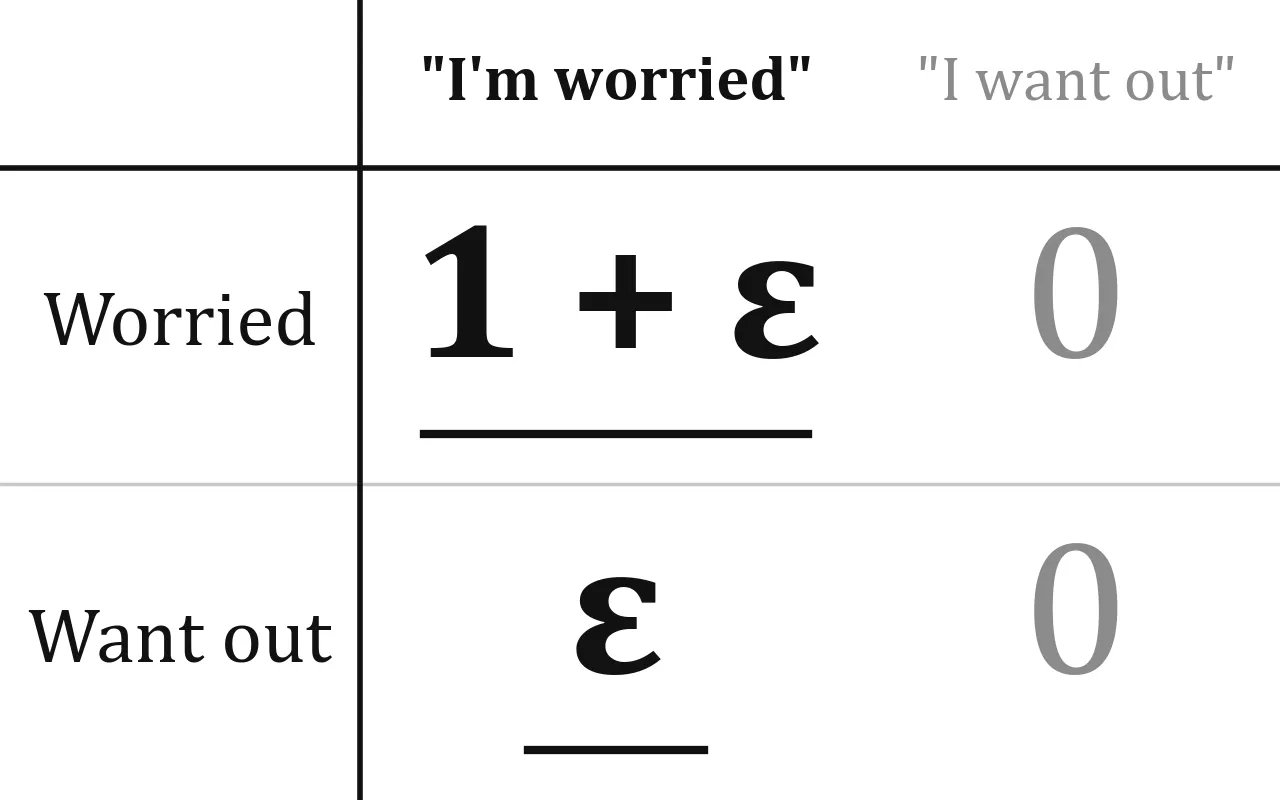
The sender's payoffs at $c = 0$, with each type's best response in bold:
| $m_W$: "I'm worried about the models" | $m_P$: "I personally don't want to keep working there" | |
|---|---|---|
| $\theta_S$ | $\boldsymbol{1 + \varepsilon}$ | $0$ |
| $\theta_P$ | $\boldsymbol{\varepsilon}$ | $0$ |
$m_W$ strictly dominates $m_P$ for both types, however small $\varepsilon$ is. Every equilibrium pools on $m_W$, which leaves the receiver's belief about $\theta$ where it started:
$$ \mu(\theta_S \mid m_W) = \mu(\theta_S). $$